Zati for veterinary practice groups
Three administrative responsibilities, one practice-group team
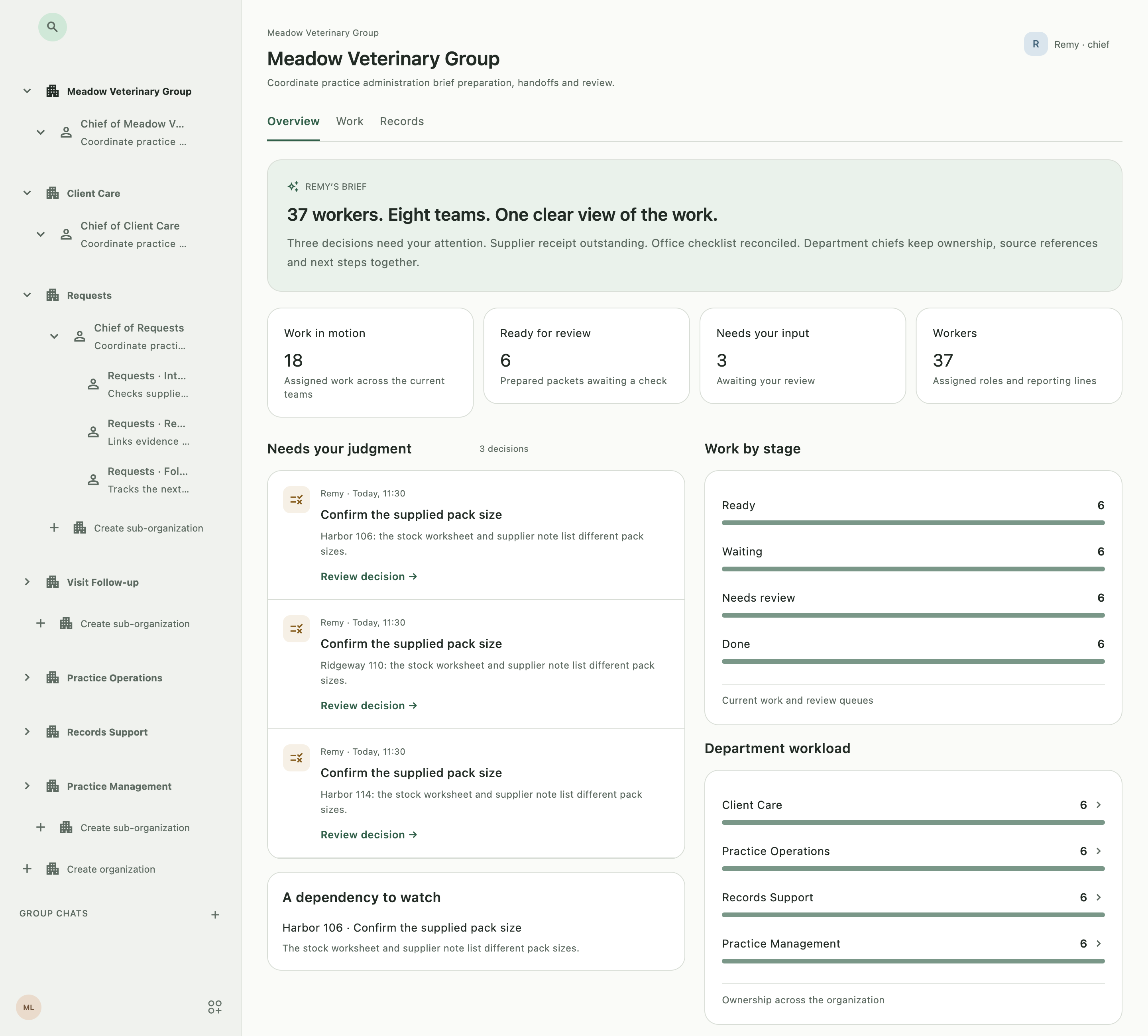
Running a group of veterinary practices means the same administrative questions arrive from every location, and each one lands in a different inbox. A stock count that disagrees with a supplier invoice. A new site whose opening checklist is half finished. A monthly summary assembled from email threads. Zati is a workspace where you can organize AI workers into a team with defined jobs, so this work has owners, outputs you can inspect, and a clear point where your people decide.
Where the week goes
Before adding any technology, name the work that repeats. Most groups identify three administrative responsibilities:
- Stock and invoice review: compare supplier invoices, stock exports and notes into a cross-location discrepancy brief with source references.
- Office readiness: use each location's administrative checklist and status notes to prepare a readiness list, marking missing inputs and a proposed owner for each.
- Management reporting: assemble approved location updates and reviewed administrative findings into a group summary with unresolved questions for the practice manager.
Choose one responsibility to configure first. The others become the natural next step once the first is producing something your managers trust.
A starting team for a practice group
Give the group a chief with a coordination role and specialists with focused assignments. A chief of administration holds the sequence, the review points and the reporting line. Under it, a stock and invoice reviewer, an office readiness coordinator and a reporting analyst each work from their own instructions, their own material and their own definition of done.
Workers carry names, purposes, skills and reporting relationships, so a conversation about a discrepancy stays with the reviewer who owns it. Separate conversations per topic keep each history intact instead of merging everything into one thread.
How work moves between them
The chain is deliberate. The research worker assembles the invoice and stock entries with their sources. The drafting worker turns them into a brief that shows both values for each disagreement and lists unanswered questions. The reviewing worker tests the draft against your instructions and flags anything unsupported. The chief reads the reviewed result and reports what remains open.
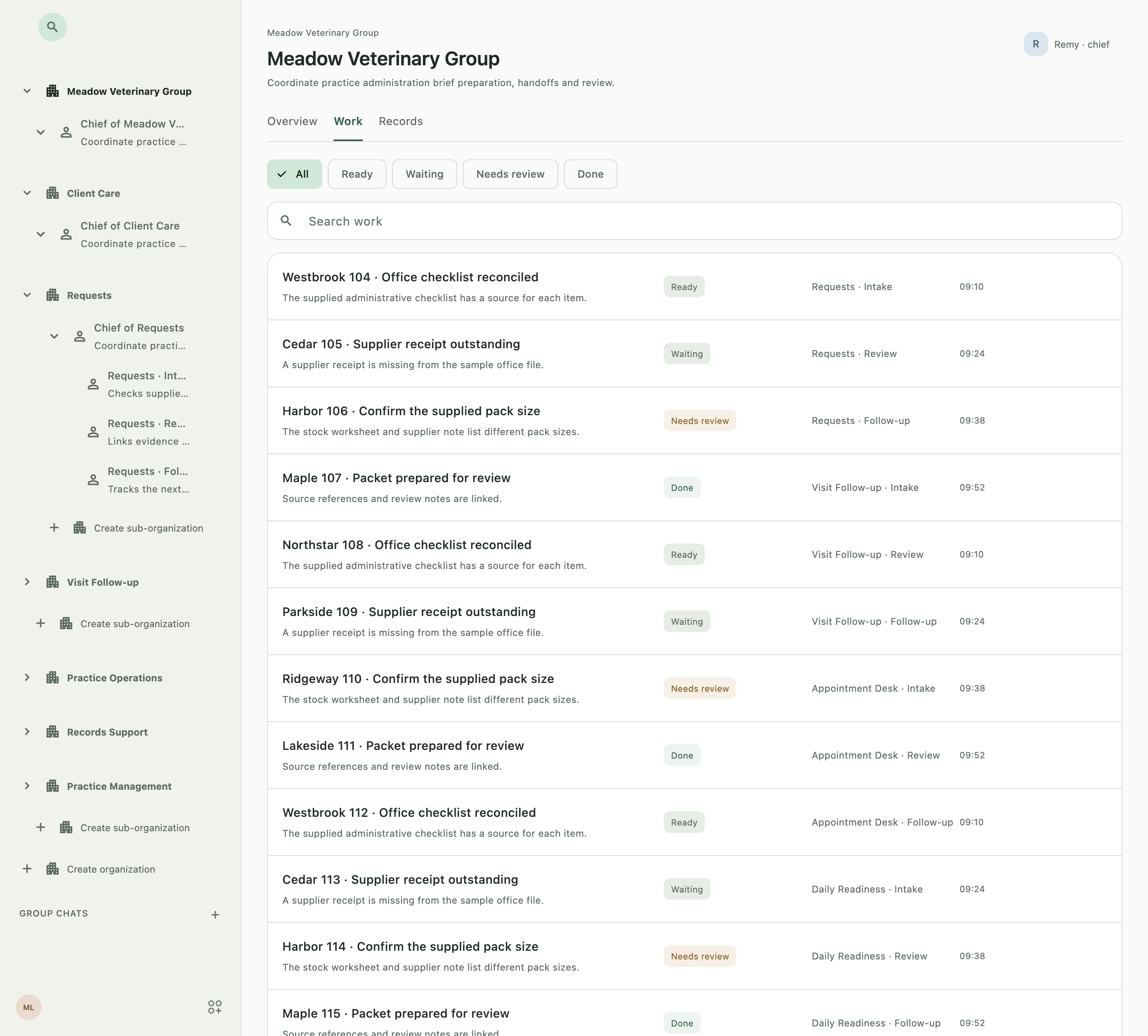
Each step has an owner, an input and an expected output, so a draft that misses the mark returns to the drafting worker rather than reaching you half finished. You can see the work list, the review queue and the next step for every item.
What you get back, and what you decide
The output is a document with a defined shape: the discrepancy brief, the readiness list or the group summary, each with source references, unresolved questions and the location affected. You can open it, check it against what you know, and reject it if the standard was not met.
The decisions stay with your people. Staff confirm quantities, pack sizes and purchasing choices. Managers approve orders or record corrections before anything reaches a supplier. Clinical and patient-care decisions remain entirely with the veterinary team. Access, permissions and resource limits are configured for the work you set up, so a worker prepares the case and your staff take the action.
Grow from what works
Once the administrative team is steady, extend it into client-service administration such as reminder lists, records-request follow-up and rebooking correspondence, keeping clinical content with your clinical staff. Set the cadence and the stop conditions for repeated reviews, and keep local exceptions separate from group-wide procedure.
Questions before you start
Is this for clinical work?
No. The starting configuration is administrative: invoices, stock, checklists and reporting. Clinical decisions stay with your veterinary team.
How much of our process do we have to change?
Less than you expect. You bring the recurring responsibility, the inputs you already have and the result your managers use today, and we shape the assignments around them.
What happens on the call?
We identify the inputs available, the brief worth producing, the workers who would own each part and the review points where your staff decide.
Start with the responsibility that costs you the most time
Bring one recurring administrative job and a sample of its inputs. We will map the team around it.